How Much Money Is Waiting at the Gate
Gate time is paid for by four parties, yet it appears in no ledger. A simple model, a worked example and a one-week method to measure it.
· 9 min read
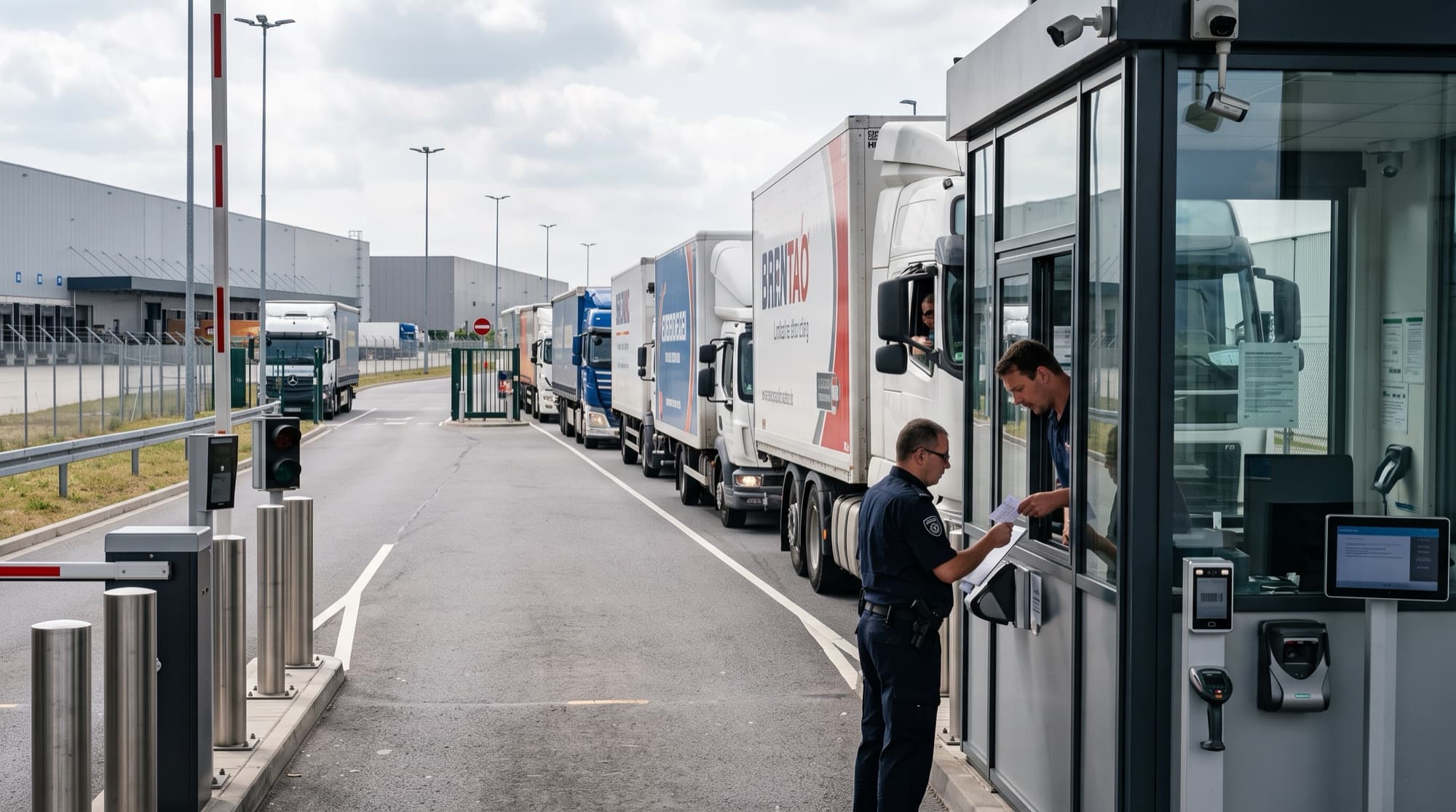
The time spent at the gate does not appear as a line in any company's ledger. It has no cost centre, no invoice, and no manager whose bonus depends on it.
It still gets paid for. Just elsewhere, under a different name, and in items that nobody labels as having arisen at the barrier.
The calculation below is not data from a specific company but a model. Its parameters can be measured in a week, and at the end I describe how. I deliberately left the conversion into forints to the reader: the price of time spent standing at the gate differs from company to company and contract to contract, but its quantity can be calculated anywhere.
Four parties pay, at the same time
The haulier. Their vehicle and driver stand idle. If the contract includes a waiting charge, it is invoiced directly. If not, the haulier builds it into the next quote, just not as a separate item. In Hungary there is no fixed waiting-time charge like the Italian one, so the question is usually settled by the contract. Some European countries already have one, though: in Italy, since summer 2025, every started hour beyond 90 minutes earns the haulier EUR 100, and according to the transport ministry's interpretation of November 2025 this cannot be waived by agreement. This shows where regulation is heading.
The internal goods-in receiver. The warehouse worker or materials handler does not work when they want to, but when the vehicle arrives. Scattered arrivals mean they have to be on standby all day instead of working in blocks.
The gatekeeper. Their pay is fixed, and it is worth saying so straight away: a faster process does not make the gatekeeper cheaper. What changes is the headcount needed at peak times, the rework caused by faulty or incomplete data entry, and how much time they spend searching instead of watching the site.
Production or the construction site. This is the largest and hardest item to measure. If the concrete or the crane is waiting for material, the damage does not arise at the gate but at the workplace, and it is orders of magnitude greater than the other three combined.
Of the four, companies usually see only the third, because that is the one on the payroll.
What makes up the time spent at the gate
The time measured is not the time of the gatekeeper's work. It runs from arrival to departure, and the actual processing is usually the smaller part of it.
- Queuing. In front of the gate, while the previous vehicle finishes. This item is not linear: if arrivals bunch into a narrow window, the queue does not grow proportionally but jumps.
- Identification. The driver gets out or hands over their documents, and the gatekeeper writes down the registration plate, name and company.
- Authorisation check. Whether they are expected, whether they have valid safety training, and who they are visiting. This step often involves phone calls, and then the time depends not on the gatekeeper but on whether someone picks up.
- Entry and briefing. Where to park, who to look for, what to put on.
- Exit. Another record, and sometimes handling a delivery note or weighbridge ticket.
The third step is the critical one. That is where it is decided whether the process takes two minutes or twenty, and where the queue forms that also affects everyone waiting behind.
It is worth paying particular attention to the fact that the average is misleading here. If half of the forty vehicles a day arrive between seven and nine in the morning, then an average transit of ten minutes means little: some of the morning arrivals wait forty minutes, and the afternoon ones two.
The formula
It needs three numbers, and all three can be measured.
Annual vehicle hours = N × T / 60 × M
Where N is the number of vehicles per day, T is the average number of minutes spent at the gate, and M is the number of working days per year.
For the internal side, the same with a different input:
Annual internal working hours = N × A / 60 × M
Where A is the minutes of internal administration per vehicle, that is, what the goods-in receiver, warehouse worker or site foreman spends on paperwork rather than on unloading.
To convert into forints, everyone uses the hourly rate from their own data. For the internal side there is a public starting point: from 1 January 2026 the guaranteed minimum wage (for skilled workers) is HUF 373,200 gross, and the social contribution tax is 13 per cent. That means an employer cost of HUF 421,716 a month, which at 174 working hours a month is about HUF 2,400 an hour. On the minimum wage, the same comes to roughly HUF 2,100. This is a lower estimate; actual wages are typically higher.
There is no such general figure for vehicle hours. If the haulage contract includes a waiting charge, that is the guide. If not, use the haulier's internal hourly cost, which is worth asking them about, because they will usually tell you.
One site, one year
Take a site with medium traffic. 40 vehicles a day, 250 working days, an average of 25 minutes from arrival to departure, and 5 minutes of internal administration per vehicle.
- Vehicle hours per day: 40 × 25 / 60 = 16.7 hours
- Annual vehicle hours: 40 × 25 / 60 × 250 = 4,167 hours
- Annual internal working hours: 40 × 5 / 60 × 250 = 833 hours
- Internal working hours in headcount: 833 / 1,750 = 0.48 FTE
- Internal working hours in forints: 833 × HUF 2,400 = HUF 2.0 million
The fourth line is the one that tends to start a conversation. Almost half a person's full annual working time goes on someone handling the data of vehicles passing the gate by hand. This half a person does not show up anywhere, because it is spread across several colleagues, a few minutes a day each.
Converting the 4,167 vehicle hours into forints depends on the contract. If the hourly waiting charge is HUF 8,000, that is roughly HUF 33 million; if it is HUF 15,000, it is roughly HUF 62 million. This money does not necessarily appear as an invoice, but it is in the freight rate all the same.
Now let us look at the difference. If the time spent at the gate falls from 25 minutes to 15, that is 1,667 vehicle hours a year. If internal administration falls from 5 minutes to 2, that is 500 working hours a year, roughly HUF 1.2 million in labour cost.
Ten minutes is not an unrealistic target, but it is not automatic either. It follows if identification and the authorisation check do not begin at the gate.
What can be reduced and what cannot
Data entry time can be reduced. If the delivery's details are already in the system because the supplier or subcontractor submitted them in advance, then at the gate you only need to identify, not record. This is the biggest one-off gain.
Authorisation check time can be reduced. If the system tells you whether they are expected and may enter, the phone calls disappear, and those do not depend on the gatekeeper.
Queue length does not depend on transit time alone. If every vehicle arrives at eight in the morning, even a fast gate produces a queue. Slot booking therefore usually delivers more than speeding up the gate itself: it does not shorten the service, it spreads the arrivals.
The gatekeeper's pay cannot be reduced. Presence at the gate is needed, and software does not replace it. What the system gives is rather that the same person can handle more gates, no second person is needed for peak times, and their working time is not spent on data entry.
Production loss can be partly reduced. If arrivals can be planned, the goods-in receiver can organise their day. If not, they stand by.
For anyone solving this with software, one point deserves to be at the centre. The gain does not arise at the gate, but from the data having entered the system earlier. So the question is whether the supplier or subcontractor can submit data themselves, not how fast the scan at the gate is.
Measure it in a week
You do not need to buy a system for the calculation. A sheet of paper and a clock are enough, for five days.
- Have the gatekeeper write down every vehicle's arrival and departure time. Two columns, nothing else.
- Calculate the difference and take the average. That is T.
- Count the vehicles per day. That is N.
- Look at the distribution over time, broken down by hour. This shows whether there is a queue or the process is just slow, and the two call for different answers.
- Ask the goods-in receiver how many minutes a day they spend on paperwork linked to arrivals. Divide by the number of vehicles. That is A.
- Mark the vehicles where a phone call was needed. Their share shows how much of the time can be eliminated.
The sixth point is the most telling. If a third of vehicles need a phone call, the gate is not slow, the preparation is missing.
Once the measurement is done, the decision no longer rests on a feeling. Until then, every conversation about it is about what each person's impression of the morning queue is.
Sources
Hidden cost audit
Discover where you are losing money with manual processes. Book a free consultation.
Free NIS2 readiness checklist
Check if your company meets NIS2 cybersecurity requirements. Download the free audit checklist.