Truck Gate: Mobile Unit or Permanently Built Gate
Mobile unit or permanently built truck gate? The purchase price is similar. What decides it is how long the gate must work and what happens to it afterwards.
· 10 min read
The question usually comes up at the project kick-off meeting: do we build a proper truck gate, or bring in a mobile unit?
Put that way, there is no good answer. The two solutions do the same job, but over a different time horizon and with a different financial logic. The choice is not a technical one. It depends on how long the gate has to work and what happens to it afterwards.
The comparison below goes through what each set-up consists of, where their cost structures differ, and the situation in which people go wrong by heading in the seemingly obvious direction.
What a truck gate has to do
Before heading in either direction, it is worth fixing what the job is. It is the same in both cases.
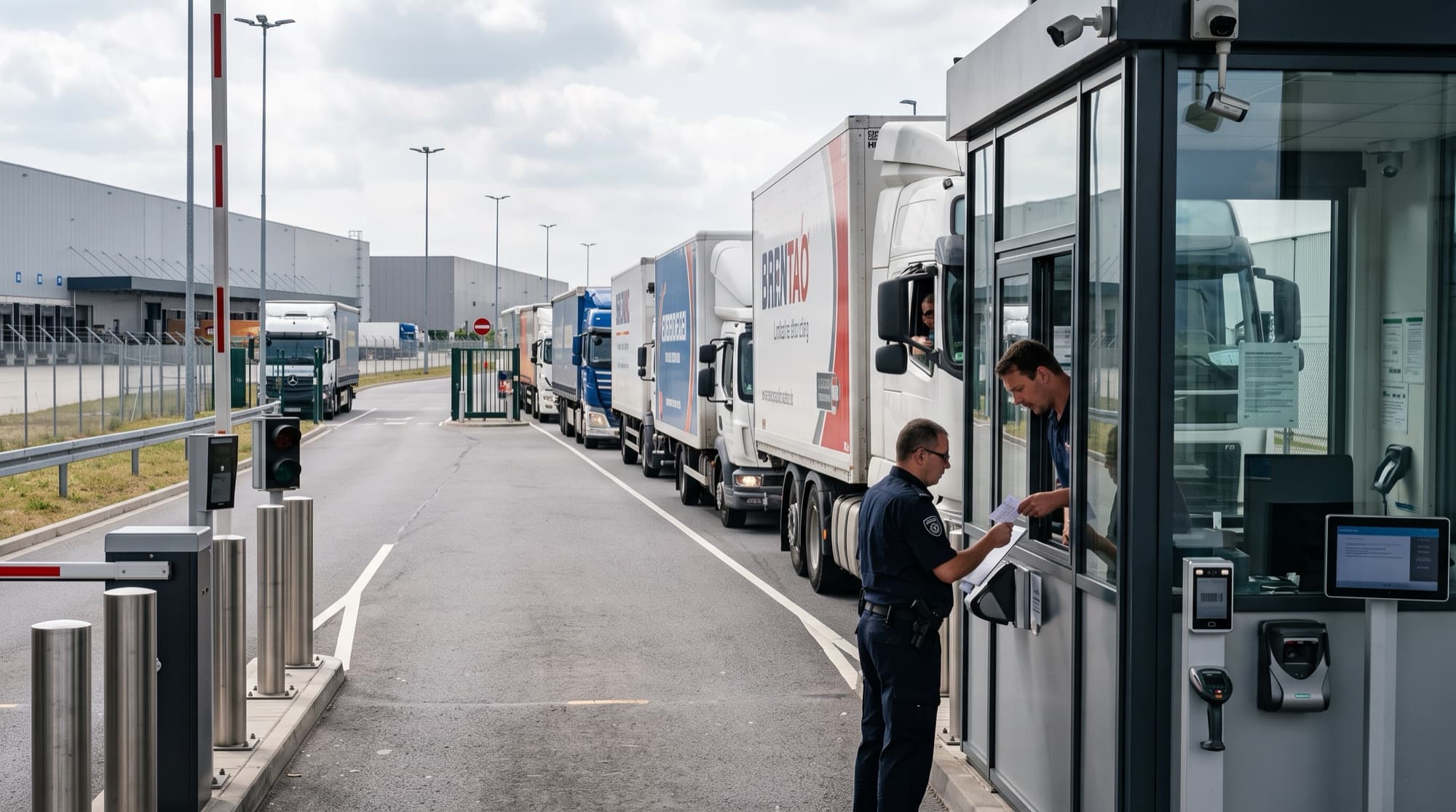
The gate has to know who and what is arriving. That means identifying the vehicle and the driver, checking whether they are expected, and recording when they came in and when they left. If the site is regulated, entry can also be conditional on valid training, a signed declaration or a prior booked time slot.
The gate also has to manage congestion. On a construction site or at a large logistics site, inbound traffic is not even: deliveries typically bunch up in the morning hours. Anyone who does not spread this across time slots is not saving on the gate, but losing out on the vehicles queuing in front of it.
Finally, there is the output: who was on site, for how long, and with what load. This is the report that matters in a dispute and during an inspection.
All three tasks can be handled with a mobile unit as well as with a permanently built gate. The difference lies in how much time and money it takes to get there.
What a permanently built gate consists of
A final truck gate is a construction investment, not an equipment purchase. This item regularly surprises anyone who only asked for the price of the barrier.
The build is made up of roughly the following types of work:
- Site preparation and foundations. The barrier, the posts and the gatehouse need a foundation, and the traffic lane needs a solid surface. If the layout changes traffic flow on the site, road building belongs here too.
- Power connection. A new metering point or branch, underground cable, protection. This is often the element with the longest lead time, because utility administration stands behind it.
- Network. Structured cabling from the gate to the server room, or fibre if the distance is long. The camera and the recognition unit need bandwidth.
- Barrier or gate. Motorised unit, loop detector, safety photocell, signal light.
- Licence plate recognition. A dedicated camera, lighting, and a camera position from which the plate is actually legible. This point often causes trouble if nobody checks the camera geometry at the design stage.
- Surveillance cameras. To record the gate and the load.
- Gatehouse or kiosk. With heating, power and a workstation set-up, if a human presence is needed.
- Software. Identification, time slot booking and reporting do not come from the barrier.
Most of the items depend on the site. The same functional scope can add up to significantly different amounts at two sites, depending on where the nearest power connection is and what the ground is like. Depending on the size of the gatehouse and local building rules, a permanent build may also require a permit procedure, which is worth checking at the design stage.
What a mobile unit consists of
A mobile truck gate provides the same function, but replaces or omits the fixed elements.
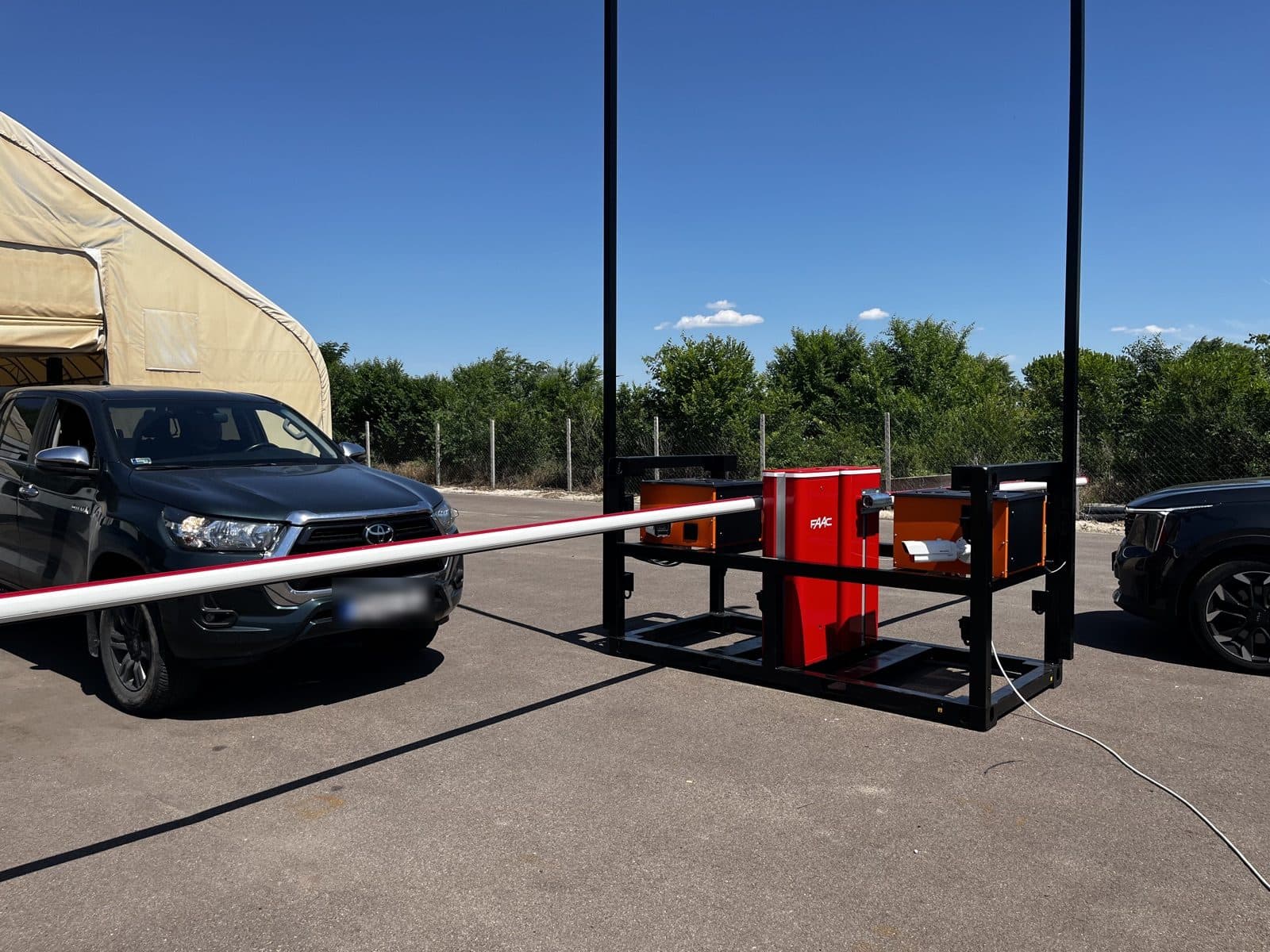
The structure itself is a pre-assembled unit that is delivered to the site and set down. It needs no foundation if the surface is level and load-bearing, as the base is part of its own structure. It needs a power supply, but not a new metering point and underground cable: it connects to a power connection that already exists on site or a temporary one. Instead of structured cabling, it communicates over a mobile network, so adequate coverage is needed on site, and identification works through the built-in reader and the software.
The key difference is not in the box, but in what is left out. There is no groundwork and no route construction, and if the site already has an existing or temporary power connection, no utility application is needed either. This removes the two elements of the investment that have the longest lead time and are the hardest to plan.
What is not removed: the software. Time slot booking, permission management, checking training and document requirements, and reporting are the same in both cases, and have to be introduced in the same way. Anyone who expects a mobile unit to bring the process with it will be disappointed.
It is also worth saying that the mobile version does not cover every need. If full physical closure is needed, for example a gate tied into the fence and shut around the clock, the mobile unit's barrier does not replace it: that requires a fixed gate and groundwork. The same applies if the reliability requirement for licence plate recognition is high: a dedicated camera position cannot be replaced.
The purchase price is roughly the same
This is where the conversation tends to turn. The purchase cost of a two-barrier mobile truck gate, with full infrastructure and every supplementary element, is on the order of HUF 5 million net*, and that is roughly in line with what a permanent build with similar functions costs.
Where the two differ is the installation, the removal, and how much of the spend is retained as value.
- Foundations, concreting. Permanently built gate: required, with labour cost and curing time. Mobile unit: none.
- Underground cable, ducting. Permanently built gate: trenching, laying, reinstatement. Mobile unit: none.
- Post erection, anchoring. Permanently built gate: every element has to be fixed in place. Mobile unit: factory-built structure.
- Power connection. Permanently built gate: a branch or new metering point, with utility administration. Mobile unit: required, but it connects to an existing or temporary power connection.
- On-site commissioning. Permanently built gate: several days of installation after the groundwork. Mobile unit: about an hour from delivery, on a prepared site.
- Removal at the end of the project. Permanently built gate: separate work, separate cost. Mobile unit: loading onto a vehicle.
- What stays on site. Permanently built gate: foundation, duct and cable, which stay on the site or are removed. Mobile unit: nothing.
- Reusable. Permanently built gate: the equipment, with a reinstallation cost. Mobile unit: the entire unit.
The decisive item is the second to last. When a permanent gate is built for a temporary site, the foundation, ducting and underground cable have no value at the end of the project. Not because they break, but because they cannot be taken away. The equipment can be dismantled and set up again elsewhere, but the work spent on fixing it in place is incurred again every time.
On the installation side the difference is even sharper. With a permanent build, days pass between the groundwork and a working system, or even weeks if a new power connection is needed, because the concrete has to cure until it can bear load, and the contractor has no influence over the utility lead time. On a prepared, level surface, with power available and adequate mobile coverage, the mobile unit is ready for operation about an hour after delivery; introducing the software is a separate matter.
Where the decision turns
If the purchase price is close to identical, the decision then mainly depends on how long the gate needs to stand there, and what happens to it afterwards.
At a permanent site, the argument favours the permanent build. In a factory, a logistics centre or a waste yard, the gate stays in one place for decades. The foundation and the cable in the ground are then not a lost expense but part of the property. A fixed structure also withstands vandalism better and provides physical closure.
For the duration of a project, the mobile unit is the rational choice. A construction site, an extension, a site compound, a seasonal site: if the gate only needs to work for a few months or at most a year or two, the groundwork put into a permanent build is lost entirely at the end of the project, and the removal is yet another item.
There is a third situation that is rarely discussed, although it is common. The site is permanent, but the location of the gate is not final: the construction schedule rearranges the traffic layout, and in six months the gate ends up twenty metres further along. With a permanent build, that means repeating all the groundwork. With a mobile unit, it is a relocation.
There is also a choice on the financing side. A mobile unit can be bought or rented. In the case of rental, under Hungarian accounting rules the fee is typically booked as a purchased service among the project's costs, and it ends when the rental contract ends. The exact accounting treatment (especially for companies reporting under IFRS and for rentals longer than 12 months) is worth agreeing with your accountant. With several parallel sites, rental is usually easier to manage than the depreciation of several permanently built gates.
The mobile solution is the wrong choice if full closure tied into the fence is needed, if the site is planning over a horizon of decades, or if licence plate recognition requires a dedicated, fixed camera position.
What to ask before deciding
Six questions push the decision one way or the other. Each of them can be answered at the design stage.
- For how many months does the gate need to work? If the answer is uncertain, that alone is an argument for the mobile solution.
- What will happen to the unit after the project? Can it be taken to the next site, or does it stay put?
- How far away is the nearest power connection, and how long is the utility lead time?
- Is barrier-based access control enough, or is full closure tied into the fence required?
- How accurate does licence plate recognition need to be, and is there a suitable camera position for it?
- Who will operate the software, and when does their training begin?
The last question is the one most often left out. The technical content of the gate is discussed for weeks, and the people who will use the system meet it in the week of handover.
- The amount shown is a net, indicative order of magnitude and does not constitute an offer. For the exact technical scope, get in touch with us.
Hidden cost audit
Discover where you are losing money with manual processes. Book a free consultation.
Free NIS2 readiness checklist
Check if your company meets NIS2 cybersecurity requirements. Download the free audit checklist.